Yá’át’ééh!
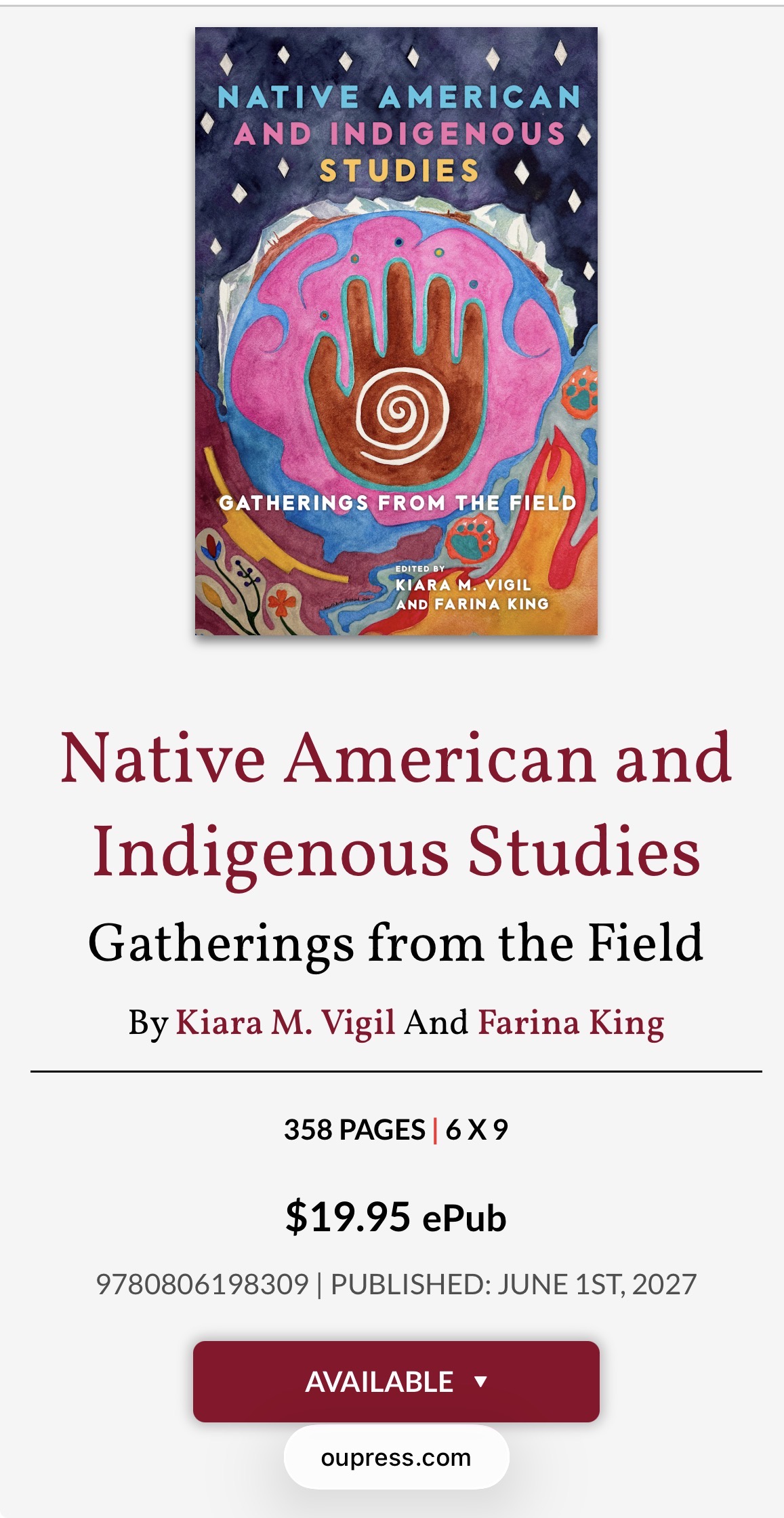
I would like to share some good news. The University of Oklahoma (OU) Press webpage for our textbook Native American and Indigenous Studies: Gatherings from the Field is now available at https://www.oupress.com/9780806198309/native-american-and-indigenous-studies/. The book is to be published in June 2027!
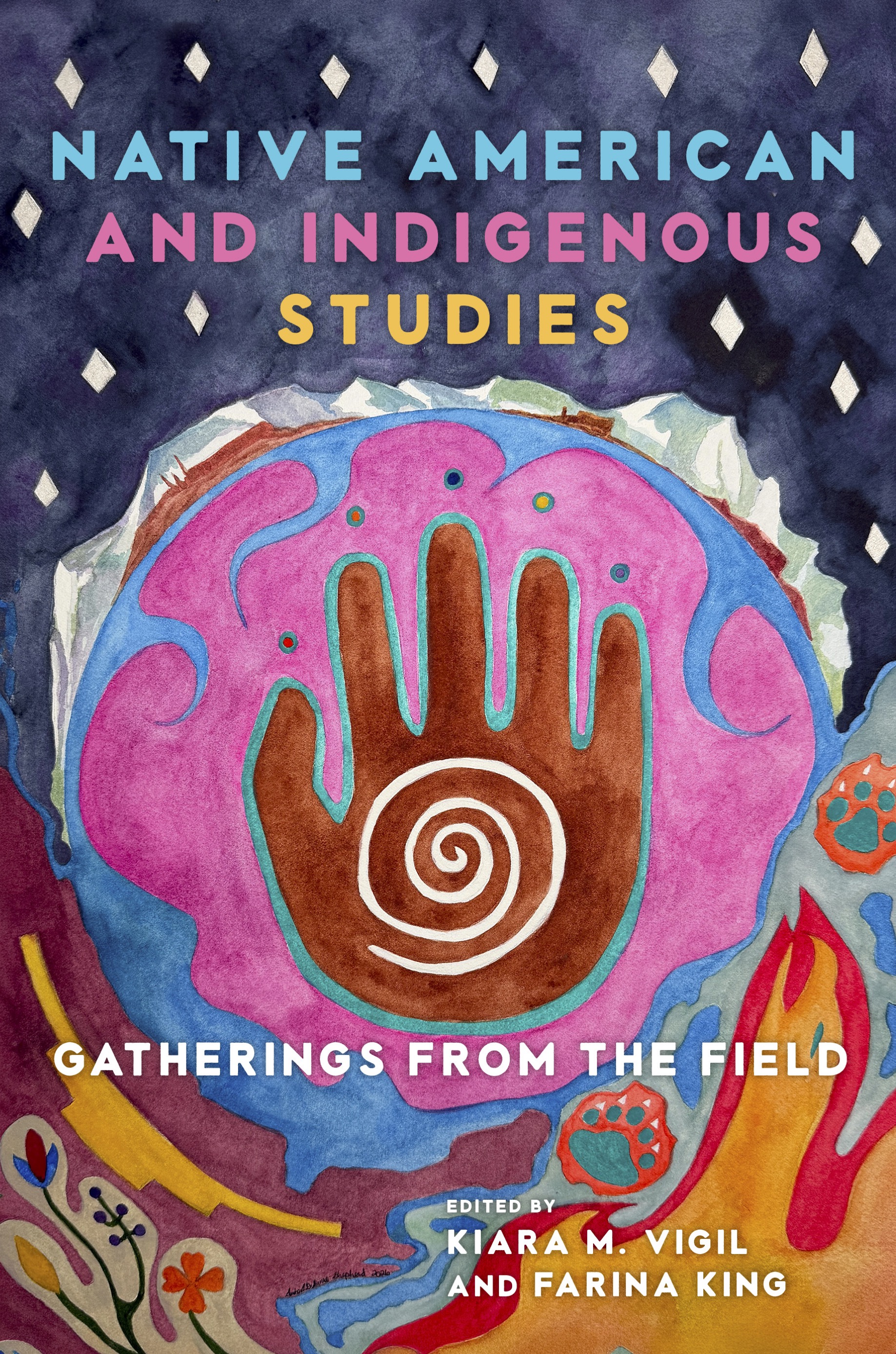
It is awesome and such an honor to work with so many amazing scholars and artists on this textbook, including 24 different authors and more contributors. Many thanks to all the contributors and editors and OU Press for getting us this far together. The cover art features Amber DuBoise-Shepherd’s original work based on the textbook drafts. Nizhóní!
More details to come soon.
Thank you to reviewers including the praise about the textbook based on early reviews:
“Across the Twenty-First Century, Native American and Indigenous Studies has become a growth field. New courses, programs, academic associations, and prominence increasingly characterize this flourishing discipline. Kiara Vigil and Farina King have brought much of this dynamism into their impressive anthology, one that seeks to bring many of the methods, insights, and findings of the field to new readers. Highly recommended.”—Ned Blackhawk (Western Shoshone), author of The Rediscovery of America: Native Peoples and the Unmaking of U.S. History winner of the National Book Award in Nonfiction
“This volume truly delivers what it promises – a foundational textbook designed for introductory-level courses in Native American and Indigenous Studies with top scholars presenting the best of the field. It fills a major gap, offering a comprehensive, interdisciplinary, and vital and accessible resource.”—J. Kehaulani Kauanui (Kanaka Maoli, Native Hawaiian), author of Paradoxes of Hawaiian Sovereignty: Land, Sex, and the Colonial Politics of State Nationalism
“Vigil and King have made a welcome and overdue contribution to Native American and Indigenous Studies (NAIS) with this edited textbook. Their work is an impressive, first of its kind NAIS text, offering an excellent introduction to the foundations and latest developments in this interdisciplinary field for students and all interested readers.”— Mary Jo Tippeconnic Fox (Comanche Nation), co-editor of American Indian Studies: Native PhD Graduates Gift Their Stories
Here are short bios of contributing authors and artists (in alphabetical order):
David Alvarez, Jr. (enrolled citizen of the Pascua Yaqui Tribe) is a PhD candidate in Native American studies at the University of California, Davis and a part of the American Indian Studies program faculty at California State University, Fresno. His research interests and expertise include American Indian education, Indigenous pedagogies, methodologies, and epistemologies, tribal curriculum, social analysis, and community based participatory research.
Christine Ami (Diné, enrolled citizen of the Navajo Nation) holds a PhD in Native American studies. Following a 14-year tenure at Diné College, she is now an associate professor at the University of California, Davis. She specializes in Indigenous research methods, traditional ecological knowledge, and animal studies, with a focus on culturally grounded curriculum development and addressing epistemological imperialism in academia.
Kelly D. Berry, Ed.D. (enrolled citizen of the Apache Tribe of Oklahoma with Kiowa and Choctaw affiliations) is an assistant professor of Native American studies at East Central University in Ada, Oklahoma. He was a previous NAS Mellon Postdoctoral Fellow at the University of Oklahoma and a Gilder Lehrman Institute of American History Scholarly Fellow who has researched Indian schools in the American colonies (1500s–1700s). He formerly served on the faculty at Riverside Indian School, the Bureau of Indian Education’s oldest off-reservation Indian boarding school and is certified to teach 5–12 social studies in Oklahoma. He serves on the board of the Oklahoma Council for Social Studies and the Oklahoma Council for Indian Education and is an editorial board member for Diné (Navajo) College Press. His work focuses on colonial-era Indian education and the historical foundations of federal Indian boarding schools.
Majel Boxer, PhD (Sisseton and Wahpeton Dakota, enrolled citizen of the Fort Peck Assiniboine and Sioux Tribes of Montana) received her master’s and doctoral degrees in ethnic studies from the University of California, Berkeley. Her research focuses broadly on tribal cultural preservation and continuance. In 2023, she was invited to serve as an inaugural board member for the Center for Colorado Women’s History. She is currently a professor of NAIS at Fort Lewis College in Durango, Colorado.
Abigail Chabitnoy (Unangan, Sugpiaq, a Koniag descendant and enrolled member of the Tangirnaq Native Village in Kodiak) is the author of In the Current Where Drowning Is Beautiful (Wesleyan University Press, 2022) and How to Dress a Fish (Wesleyan University Press, 2019), shortlisted for the 2020 International Griffin Prize for Poetry and winner of the 2020 Colorado Book Award. Her poems have appeared in Hayden’s Ferry Review, Boston Review, Tin House, Gulf Coast, LitHub, SAIL, and Red Ink, among other publications. She is currently a mentor for the Institute of American Indian Arts low-residency MFA in creative writing and is an assistant professor at University of Massachusetts, Amherst. Abigail holds an MFA in creative writing from Colorado State University and a BA in anthropology from Saint Vincent College. Find her at salmonfisherpoet.com.
Dwain Coleman, PhD, (descendant of Africans, Europeans, and Kaw and Osage Natives) is an assistant professor of history at the University of Utah, studying the history of African Americans, the Civil War era, the environment, Latter-day Saints, and Native Americans. He is also the codirector of the Iowa Colored Conventions Digital Project.
Wade Davies is a professor of history at the University of Montana, Missoula, where he teaches courses on Native American history, western history, and sports history. His books include Native Hoops: The Rise of American Indian Basketball, 1895–1970 (2020) and Healing Ways: Navajo Health Care in the Twentieth Century (2001).
Teagan Reede Dreyer (enrolled citizen of the Choctaw Nation of Oklahoma) is a doctoral candidate in history at Oklahoma State University, concentrating her research on the history and impacts of Native American boarding schools.
Amber L. DuBoise-Shepherd (enrolled citizen of the Navajo Nation) depicts contemporary Native American narratives based on her family heritage of Diné/Navajo, Sac & Fox, and Prairie Band Potawatomi. She has an AA from Seminole State College and BFA from Oklahoma State University with a minor in Business Entrepreneurship. Her mixed media pieces, digital drawing, and oil paintings reference an illustrative quality. From her Diné side, she is born into her maternal clan Kinłichii’nii and from her maternal grandfather Tó’ahaní. From her Sauk side, she is born into the Mahwêwithowa clan, and her Sauk name is Mokehmêhshe. DuBoise-Shepherd grew up in a diverse Native household and experienced many cultural aspects from her family including Diné weaving, Diné, silversmithing, Woodland ribbon work, fashion, and beadwork. She has exhibited her artwork in over 40 exhibitions since graduating from OSU in 2016, has curated and guest curated several exhibitions over Indigenous artforms, taught art courses, and given lectures. In 2023 she was awarded The Rising Star Alumni Award at the OSU, College of Arts & Science Hall of Fame ceremony.
Bridget L. Groat, PhD, (Alaska Native of Iñupiaq, Alutiiq, and Yup’ik descent, enrolled member of Naknek Native Village) is an assistant professor of Native American studies at California State University, Channel Islands. Her research interests include Alaska Native history, nineteenth- and twentieth-century Native American history, Indigenous women’s history, oral history, Indigenous food sovereignty, Indigenous environmental history, and public history. She is currently working on a monograph about the Bristol Bay salmon fishery.
Edward Leon Guerrero, a CHamoru activist and educator, serves as a doctoral researcher at Pompeu Fabra University. His work focuses on perpetuating CHamoru culture and history through education and advocacy.
Lynne Hardy (enrolled citizen of the Navajo Nation) is an illustrator from Cameron, Arizona. She is a full-time illustrator who creates art based on her Diné (Navajo) culture. She started her small online art business in 2020, creating products inspired by her Navajo culture.
Michael David Kaulana Ing (Kanaka Hawaiʻi) earned his PhD from Harvard University in 2011. Formerly a professor of religious studies at Indiana University, he is now on the faculty in the Department of Philosophy at the University of Hawaiʻi-Mānoa.
Dustin Jansen (Diné, enrolled citizen of the Navajo Nation) is an associate professor of American Indian studies and political science at Utah Valley University and an advocate for Indigenous education and cultural preservation, as program coordinator for the minor in American Indian studies. With expertise in Native American law and governance, he works to empower students and Indigenous communities through education and advocacy. Dustin also serves as director of the Utah Division of Indian Affairs, where his focus is on creating positive working relationships between the state of Utah and the eight federally recognized tribes in Utah.
Doug Kiel (enrolled citizen of the Oneida Nation) studies Native American history, with interests in the Great Lakes region and twentieth-century Indigenous nation-rebuilding. He is an associate professor in history at Northwestern University and faculty affiliate for the Center for Native American and Indigenous Research (CNAIR).
Farina King, PhD, (Diné, enrolled citizen of the Navajo Nation) is the Horizon Chair of Native American Ecology and Culture and a full professor of Native American studies at the University of Oklahoma. Her research interests include Native American and Indigenous studies, Native American history, ethnohistory of North America, comparative colonial history, oral history, history of Native American education, the American West and Southwest studies, Native American and Indigenous Women’s studies, and public history. She is the author of The Earth Memory Compass: Diné Landscapes and Education in the Twentieth Century, Diné dóó Gáamalii: Navajo Latter-day Saint Experiences in the Twentieth Century, and coauthor of Returning Home: Diné Creative Works from the Intermountain Indian School, among other publications.
Mary Klann is an adjunct lecturer in ethnic studies at the University of California, San Diego, where she teaches classes in Native American history and Indigenous worldviews. She is the author of Wardship and the Welfare State. She holds a PhD in US History from the University of California, San Diego.
Lloyd L. Lee, PhD, (enrolled Navajo Nation citizen) is Kinyaa’áanii (Towering House), born for Tł‘ááshchí’í (Red Cheeks). His maternal grandfather’s clan is ‘Áshįįhi (Salt) and his paternal grandfather’s clan is Tábąąhá (Water’s Edge). He is professor of Native American studies, director of the Center for Regional Studies (CRS), and editor of the Wicazo Sa Review journal at the University of New Mexico.
Drew Lopenzina is professor of early American and Native American literatures at Old Dominion University. He is the author of three books: The Routledge Introduction to Native American Literature (Routledge, 2020), Through an Indian’s Looking Glass: A Cultural Biography of William Apess, Pequot (University of Massachusetts Press, 2017), and Red Ink: Native Americans Picking up the Pen in the Colonial Period (SUNY Press, 2012).
Marcus C. Macktima (Sengaa dí’ nashāā, enrolled citizen of the San Carlos Apache Tribe) belongs to the K’Aintci’ Dn’ Clan and descends from the Hopi Tribe and Apache Tribe of Oklahoma. He is an assistant professor in the Department of History at Northern Arizona University and is an affiliate with the Applied Indigenous Studies Department. Additionally, he teaches Apache History at San Carlos Apache College. Dr. Macktima earned his PhD in history from the University of Oklahoma.
Chelsea Mead is a professor of history at Minnesota State University, Mankato. She holds a PhD in American history and comparative global Indigenous studies, with specializations in linguistics, anthropology and twentieth-century US Native America from Arizona State University.
Jeromy Miller (enrolled citizen of the Cherokee Nation) is a professor in the Cherokee and Indigenous Studies Department at Northeastern State University in Tahlequah, Oklahoma.
Elizabeth James-Perry (enrolled citizen of the Wampanoag Tribe of Gay Head-Aquinnah) is a 2023 National Endowment for the Arts National Heritage Fellowship and Massachusetts Cultural Council Traditional arts fellowship 2014 Awardee. She specializes in watercolor painting, textiles arts, and sculptural wampum jewelry on handspun milkweed. She worked to recapture knowledge and rekindle broad interest in seventeenth century Wampanoag life and diplomatic relations. The artist was honored to be a 38th Voyager onboard the historic Charles W. Morgan whaling vessel, as a descendant of the Gay Head crewmembers. She holds a degree in Marine Science from the University of Massachusetts Dartmouth 2001, and a certificate for Digital Tribal Stewardship from Washington State University 2016. Employed for a decade within the Aquinnah Tribal Historic Preservation Office, she served as Federal Tribal Co-Lead of the Northeast Ocean Planning Body and with the Culture and Heritage Committee during USET Conferences. She has published research and served on the Tribal Advisory Board for Radcliffe’s Digital Archive project. A member of a Nation that has long harvested the sea, Elizabeth’s perspective combines Algonquian traditional ecological knowledge, genealogy, art, and science in her ways of relating to life on the North Atlantic.
Katrina M. Phillips, PhD, (enrolled citizen of the Red Cliff Band of Lake Superior Ojibwe) is an associate professor of history at Macalester College. She’s the author of Staging Indigeneity: Salvage Tourism and the Performance of Native American History (UNC Press, 2021), and her current research examines activism, environmentalism, and tourism on and around the Red Cliff Reservation in northern Wisconsin. She is also the author of numerous children’s books, including I Am on Indigenous Land (2025), Water Is Life: The Ongoing Fight for Indigenous Water Rights (2022), and Female Indigenous Heroes: 51 North American Women from the 1800s to Today (2026).
Heather Ponchetti Daly (enrolled tribal member of the Iipay Nation of Santa Ysabel) is an assistant professor of history and affiliated faculty in the Departments of Environmental Studies, the Design Lab, Indigenous Futures Institute, and Scripps Institution of Oceanography at University of California, San Diego. Her research focuses on federal Indian law and policy in California Indian Country, and her future research engages with food sovereignty as both practice and theory. Specifically, she is actively designing the Indigenous Food Sovereignty Lab at UC San Diego. She received her PhD in history from the University of California, Los Angeles.
Asa “ACE” Samuels (enrolled citizen of the Cheyenne and Arapaho Tribes with roots in the Choctaw Nation of Oklahoma) is an artist, researcher, and advocate for Tribal sovereignty and cultural revitalization. He completed an undergraduate degree at the University of Oklahoma with dual majors in biology and Native American studies. His current work, “No Goodbyes,” shares stories and knowledges of culturally significant relatives across Turtle Island impacted by climate change and colonization, emphasizing Tribal sovereignty in ecosystem stewardship. Through his art, research, and community engagement, he advances work in climate adaptation, wildlife conservation, food sovereignty, language revitalization, Tribal education, and meaningful Tribal engagement.
Ty Smart (enrolled citizen of the Cherokee Nation) is a PhD candidate in English literature at the University of Massachusetts, Amherst. Their research focuses on North American Indigenous narratives of Indigenous slipstream—stories in which characters move between the past and future to create an Indigenous present.
Veronica E. Tiller (enrolled citizen of the Jicarilla Apache Nation) is a writer of Native American history and is editor and publisher of the award-winning economic reference guide covering 362 modern Indian tribes: Tiller’s Guide to Indian Country. She has published other books on Apache culture, customs, and history.
Davina Ruth Two Bears, PhD, (Diné, enrolled citizen of the Navajo Nation) is originally from Tsidi To’ii (Birdsprings), Arizona. She is an Indigenous archaeologist and assistant professor in the School of Human Evolution and Social Change at Arizona State University. Her research focuses on the early history of the Leupp Indian School, a federal Indian boarding school which currently exists as a historical archaeological site, and the reuse of the Leupp Indian School as a Japanese Citizen Isolation Center in 1943 during World War II.
Kiara M. Vigil, PhD, (Dakota, Špayo, Šagdašiƞ, and Iyašíča ancestry) is professor of American studies, Chair of Education Studies, and Dean of New Students at Amherst College. Her interests include Native American and Indigenous studies, American studies, and American history, literature, and cultural studies. She is editor-in-chief of the Oxford Bibliographies in Indigenous Studies and editor of the journal Studies in American Indian Literatures. She is a series editor for the Lyda Conley Series on Trailblazing Indigenous Futures for University Press of Kansas. She is author of Indigenous Intellectuals: Sovereignty, Citizenship, and the American Imagination, 1880–1930 and several peer-reviewed articles and book chapters.
Maxwell Yamane is an assistant professor of ethnomusicology at the University of Oklahoma with special interests in Indigenous language reclamation and music, powwow, and Indigenous protest. He is Japanese American and conducts community-based music and sound research with Native communities in Oklahoma and Washington, DC.
Ahéhee’!

