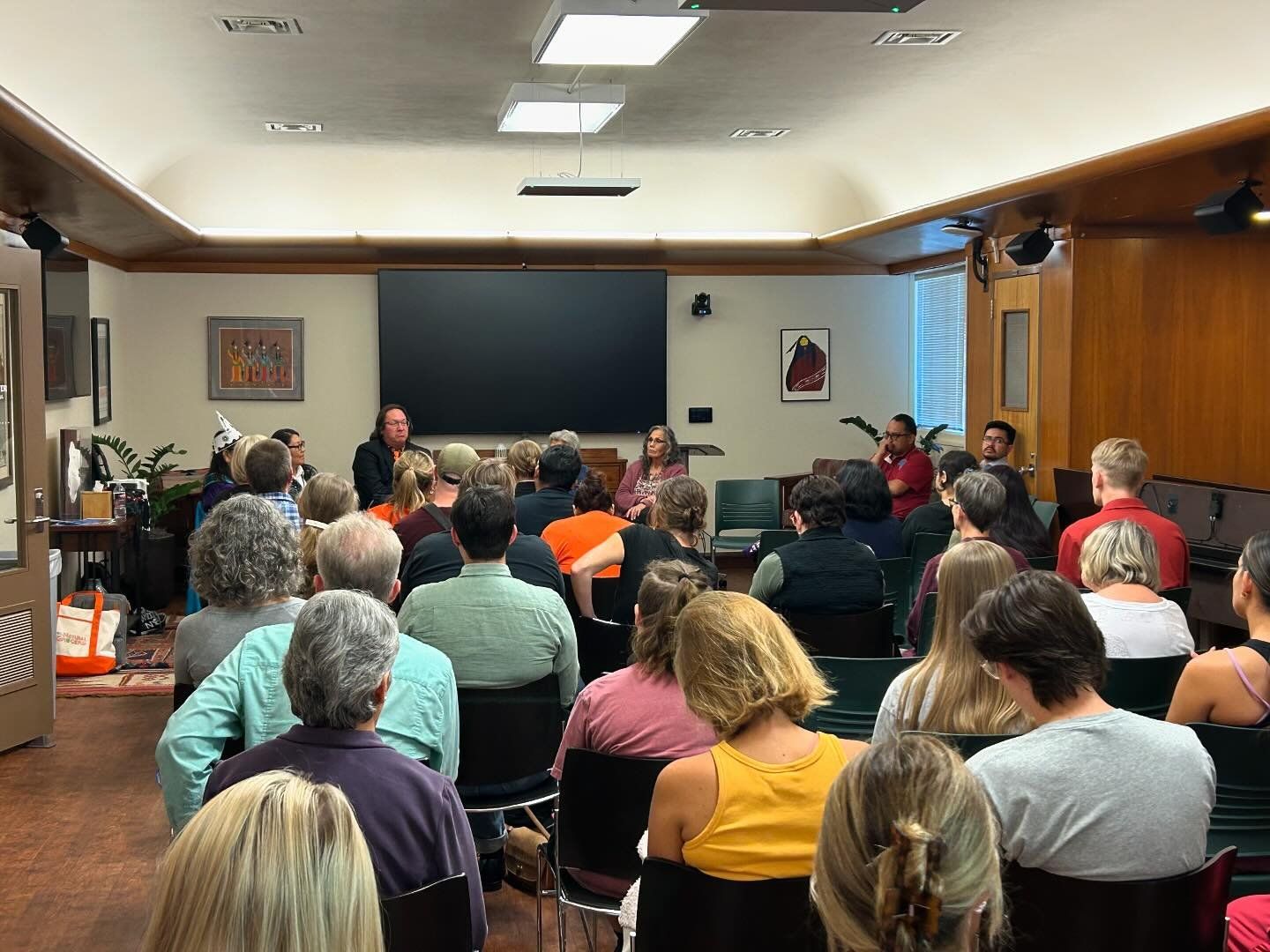
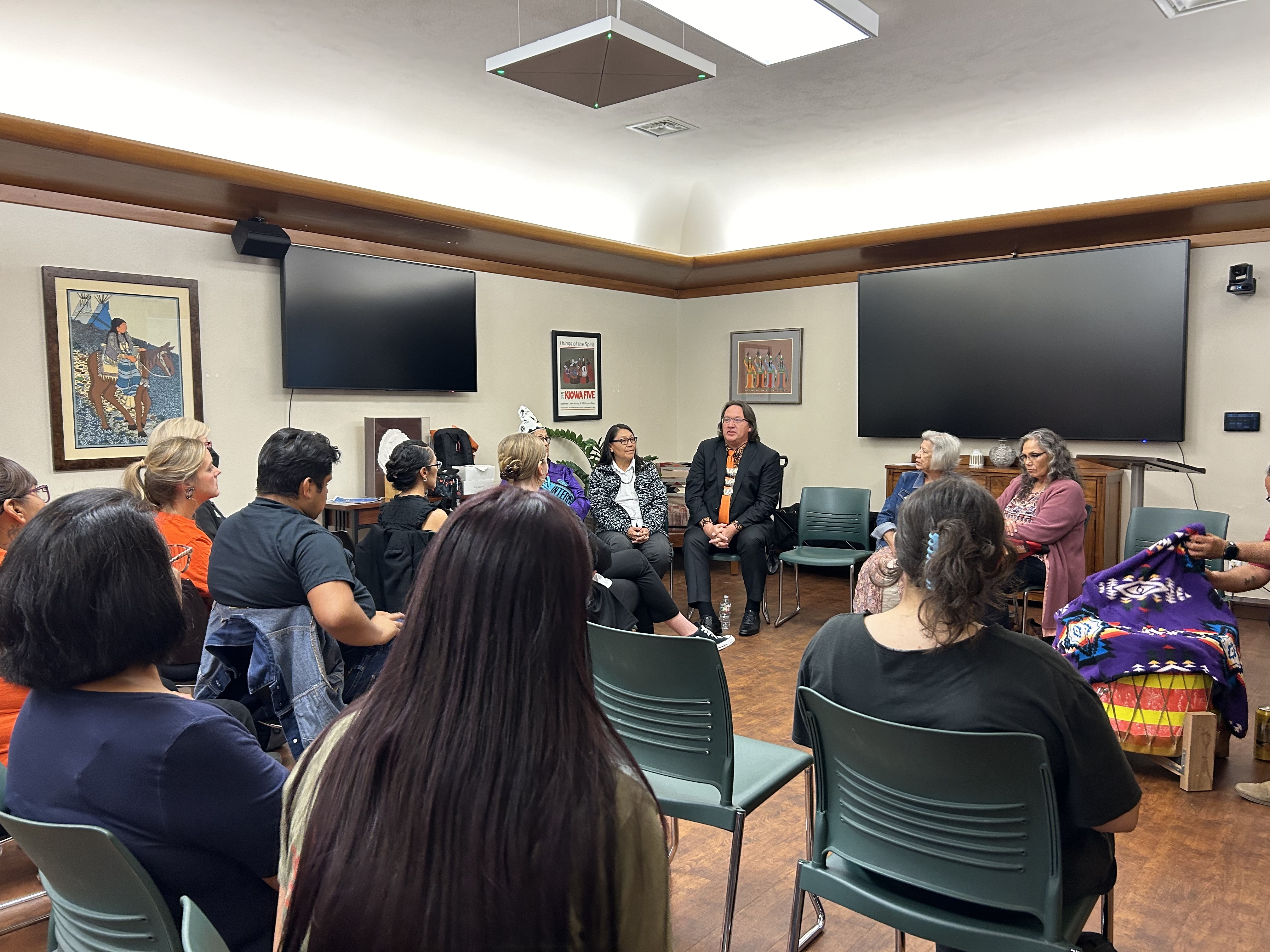
On August 26, 2025, I helped to organize a public panel for the 2nd workshop of an ongoing collaboration, “Indigenous Truthtelling of Boarding Schools.” I worked with Brian D. King to edit the recording of the panel with the permission of the panelists for an episode of the Native Circles podcast (see the podcast website). I share the transcript of the episode below, which is accessible on the podcast website. This episode features voices from the panel held at the University of Oklahoma and funded by a NHPRC-Mellon Planning Grant for Collaborative Digital Editions in African American, Asian American, Hispanic American, and Native American History and Ethnic Studies. The panelists share their experiences studying Native American boarding schools and discuss plans for a digital edition with scholars at the University of Oklahoma (OU), Oklahoma State University (OSU), Northeastern State University (NSU), Utah State University (USU), and Indigenous communities. The project connects universities and archives with Native Nations and communities to develop educational resources about boarding schools and to expand public access to records, oral histories, and community knowledge, following Indigenous protocol.
Indigenous Truthtelling of Boarding Schools (August 2025) Panel
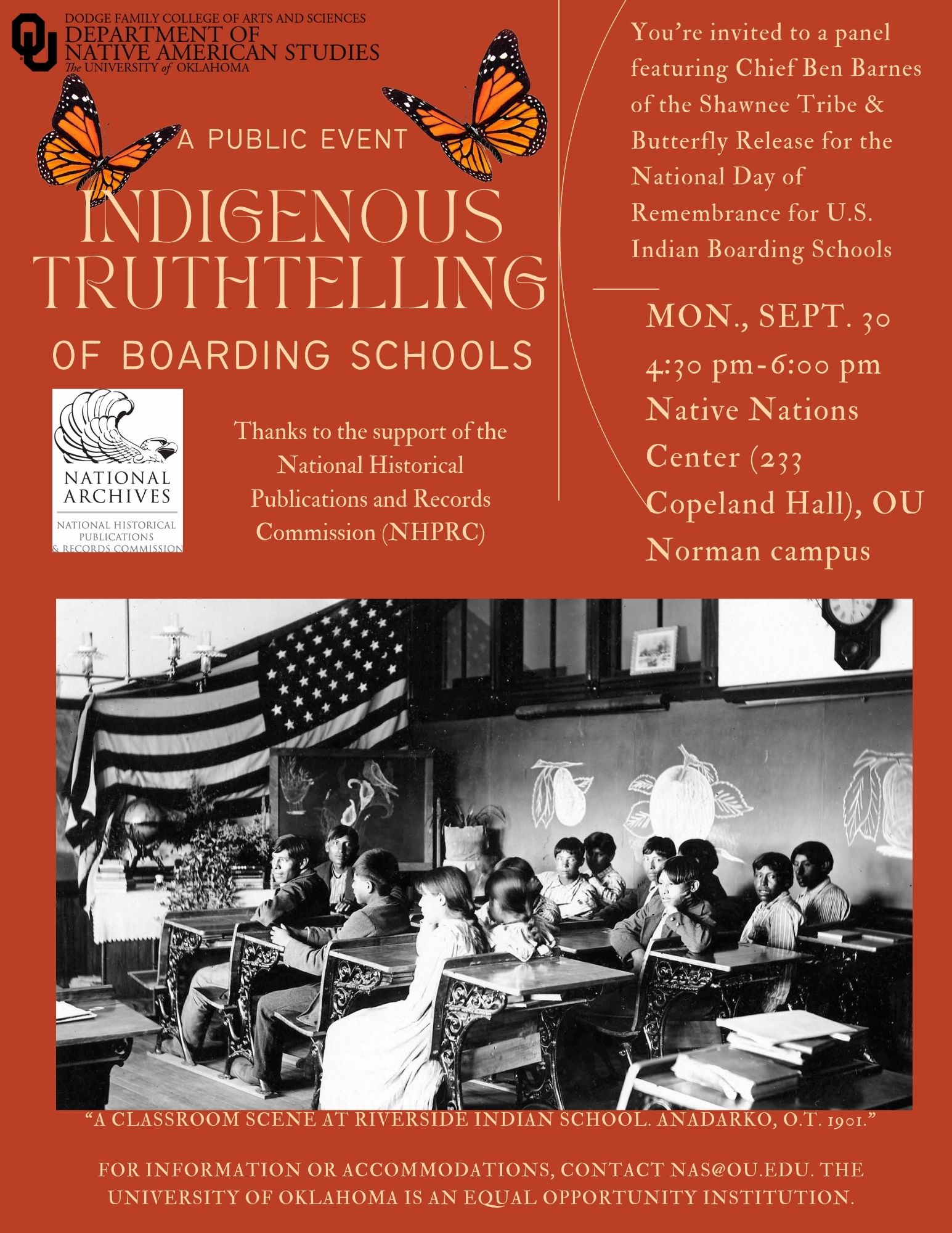
As a part of an initiative for Indigenous Truthtelling of Boarding Schools, I helped to organize a public panel and event on September 30, 2024, for the National Day of Remembrance of U.S. Indian Boarding Schools, which The Norman Transcript covered in the article, “Indigenous Truthtelling: Remembering the impact of U.S. Indian Boarding Schools” (written by Zack Wright, posted on October 1, 2024). For a planning grant, between 2024 and 2026, I am working with librarian Lina Ortega (Sac and Fox), Dr. Bonnie Pitblado, Dr. Chengbin Deng, Cheyenne Widdecke, Dr. Nina Bledsoe, and Dr. Belinda Biscoe and others at the University of Oklahoma (OU) along with several universities and communities in Oklahoma and Utah for the project, Indigenous Truthtelling of Boarding Schools. The project received $120,000 funding through the NHPRC-Mellon Planning Grants for Collaborative Digital Editions in African American, Asian American, Hispanic American, and Native American History and Ethnic Studies, beginning in 2024. This grant announcement was highlighted in the article, “Two OU-Led Digital Projects Receive National Archives Funding.”
Public Event Flyer for September 30, 2024
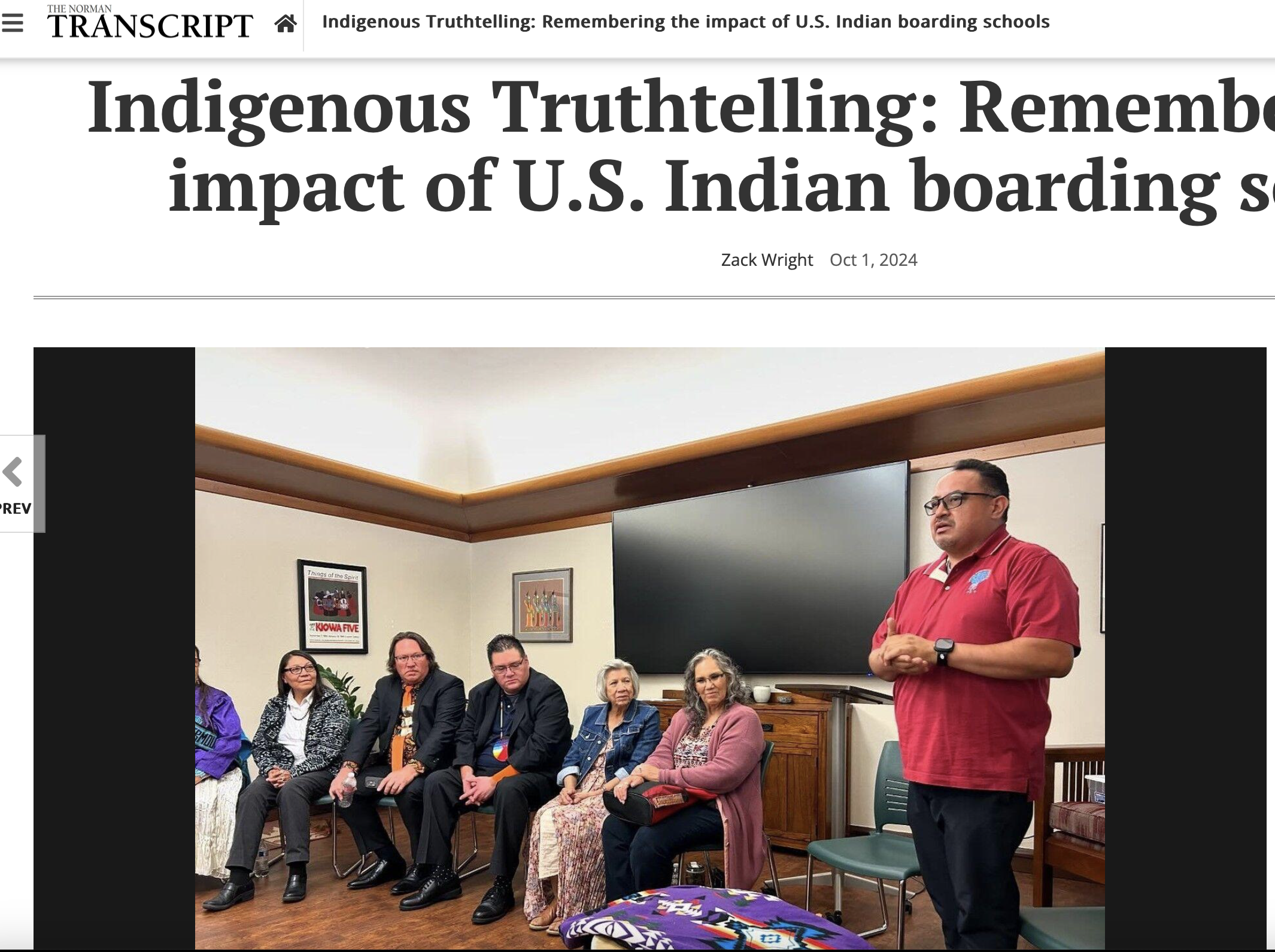
The Norman Transcript article with photo of Gay Dawn Pinnecoose, Chief Ben Barnes, Dr. Kelly Berry, Carole Fife Stewart, Pamela Hurt, and Oliver Plumley
For this collaborative project, Indigenous Truthtelling of Boarding Schools, we will develop a digital edition that connects a mass amount of information from various archival collections in Oklahoma and Utah for access to educational resources about Native American boarding schools through different Indigenous perspectives with an emphasis on oral history, art, and archaeology. Our team of Native American Studies scholars, historians, archivists, librarians, art historians, museum specialists, curriculum designers, archeologists, geographers, and educators with Indigenous boarding school survivors/alumni and their descendants are working together to build a digital edition framework for educators and learners of a wide spectrum of ages and backgrounds. This digital edition will become a hub for linking classroom adoption plans and materials about Native American boarding schools with possibilities for use from local, national, to international levels. We seek to present a gateway to historical sources that show the constellation of diverse Native American boarding schools, their contexts, time periods, and people involved and affected by them.
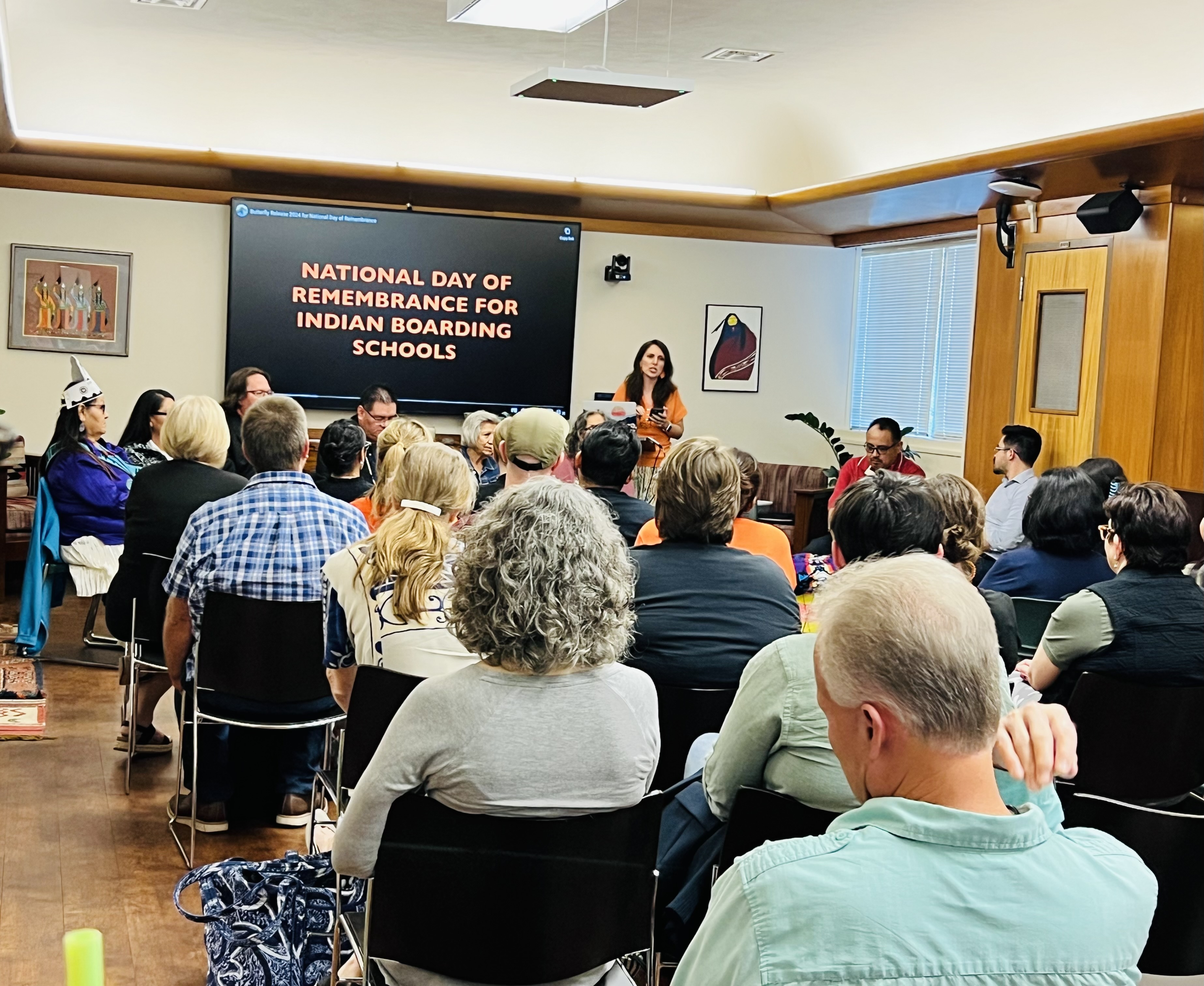
Farina King at the Indigenous Truthtelling panel, September 30, 2024
The historical timeframe and themes of the digital edition derive from the contributors and their focus areas, a broad range of dates and places, but all feature Native American boarding school student oral histories, art, creative works, and primary sources between the late nineteenth century and twentieth century in Oklahoma and Utah. The project team will select sources from extensive digital collections of Native American boarding schools, including the Utah State University (USU) Digital History Collection of the Intermountain Indian School, the USU Nora Eccles Harrison Museum of Art and the Intermountain Indian School murals, the Oklahoma State University (OSU) Chilocco Indian Agricultural School Collection, the University of Oklahoma (OU) Western History Collection (WHC), and the Special Collections and Archives of Northeastern State University (NSU).
Indigenous Truthtelling of Boarding Schools Preliminary Workshop Fall 2024 Group Photo
The collaborative team will contextualize the chosen sources from the contributing collections to help the public, especially educators and learners, to access the transcripts of oral histories and samples of primary sources that they can apply to lesson plans. This digital edition will highlight how the variety of Native American historical experiences and impacts of boarding schools, including those funded by the federal government, denominations, and Native Nations themselves, matter to understanding the present and future. Most importantly, we will work with the Native American and Indigenous communities and peoples affected by these specific boarding schools and policies, following and listening to their guidance and what they want the public to learn and understand about their diverse experiences and impacts of the schools.
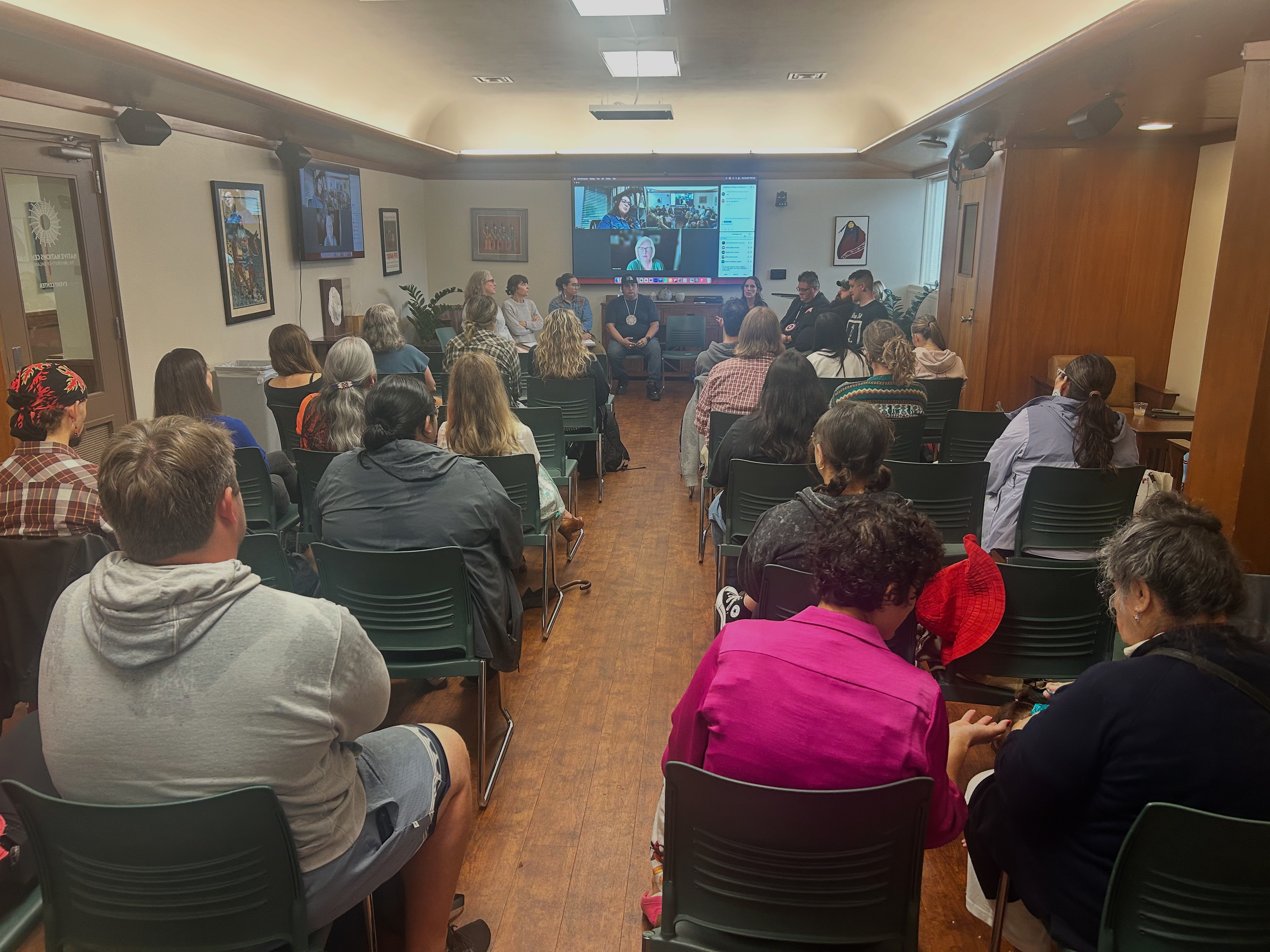
Our team held a preliminary workshop, from September 30 to October 1, 2024, in the Native Nations Center event room on the OU-Norman campus to review and set our objectives and goals, planning for our next steps and processes. The panel was the only public session of the workshop, which featured Chief Benjamin Barnes of the Shawnee Tribe. The Norman Transcript article (by Zack Wright) highlights most of the panel, which also included NAS Mellon postdoctoral fellow Dr. Kelly Berry, Intermountain Indian School alumni Lorina Antonio and Gay Dawn Pinnecoose, and Chilocco Indian School alumni organization leaders Pamela Hurt (historian), and Carole Fife Stewart with songs shared by Oliver Plumley (Otoe/Comanche/Lakota) and Dr. Max Yamane.
Indigenous Truthtelling of Boarding Schools public panel (September 30, 2024), OU-Norman campus
The reporter, Zack Wright, referred to my opening remarks of the panel, during which I shared my father’s boarding school survival story. He mistakenly noted that my father ran away from the Fort Wingate boarding school, where my father attended as a small child. However, my father ran away from the American Indian school dormitory of the Ramah school in New Mexico, which was another form of boarding schools that are often overlooked- a public school with a Native American student dormitory that paralleled boarding school experiences. Also, Wright mentioned how we shared a video of the butterfly release (that featured a recording of Diné healer, James Peshlakai, singing a butterfly song), honoring and remembering the Native American boarding schoolchildren and youth who never returned home from school. We did not release Monarch butterflies, although I referred to how Oklahoma is on the route of the Monarch butterflies’ journey. The children in the featured video actually released butterflies known as the Painted Lady.
I am so grateful for that day and panel to hear many stories and voices of the people most affected by Native American boarding schools and policies. Chief Barnes is leading a way for Native Nations and peoples to shape and engage in this crucial work. He works closely with the National Native American Boarding School Healing Coalition (NABS), and he has testified widely to various audiences, including local and national leaders, calling for the social justice and recognition of the harms of the U.S. Indian Boarding School policies and system. Under the leadership of individuals such as Chief Barnes, the Shawnee Tribe is uncovering the truth and lived experiences of their people at the Shawnee Indian Manual Labor Boarding School (1839-1862) in Fairway, Kansas.
Other panelists included active members of Native American boarding school alumni from the Chilocco and Intermountain schools, who often share their life stories that move beyond only damage-centered narratives of Native American histories and peoples. They remind us to see them as dynamic and vibrant communities and human beings.
Lorina Antonio (Diné) talks at the Indigenous Truthtelling panel, Sept. 2024
Dr. Kelly Berry (Apache of Oklahoma) talks at the Indigenous Truthtelling panel (Sept. 2024)
Chief Benjamin Barnes of the Shawnee Tribe talks at the Indigenous Truthtelling of Boarding Schools panel (Sept. 2024)
Considering the National Day of Remembrance of U.S. Indian Boarding Schools, following the federal recognition in Canada of the National Day for Truth and Reconciliation, there is much hope that the United States will finally acknowledge and put forth the efforts and resources needed for the social justice, the knowledge, and the teaching about Native American boarding schools. When planning this preliminary workshop, it was what some might call a coincidence, since I did not initially plan for it to be on the same day of remembrance. But some say there is no such thing as coincidence, and it all came together. This is a part of what I shared with the preliminary workshop attendees, which I might have repeated in some way during the public panel.
During the workshop, I highlighted the origins of the project and how it all began. My father, Phillip Lee Smith, first went to the Fort Wingate Boarding School when he was five years old. He was dropped off without warning. He did not speak English, and immediately was reprimanded and punished for speaking the only language he knew. I have referred to this family history in my books and previous publications. He was born and raised in a hogan. And our family is from a region called Rehoboth, near Gallup, New Mexico. There was actually a Christian Reformed mission built on our people’s homelands, then known as the Rehoboth Mission. By the early 1900s, they established a mission boarding school there where my grandmother went along with different relatives. Many boarding schools entangle with my family history.
Initially, I started to talk about boarding schools with my uncle Albert Smith, who was a Navajo Code Talker. I asked him about the war, and he started to tell me about his childhood and how he was in the Crownpoint Indian boarding school, which is an on-reservation Navajo Nation boarding school, where he was forbidden to speak Diné bizaad (Navajo language). At the time, I knew he had used the Navajo language as a shield, a defense or a weapon, in World War II, so I was shocked. That was the first time, as a child or a youth, that I was introduced to Native American boarding school policies and trauma. I had heard that my dad went to a boarding school, but I did not think anything about it before, because my father did not talk about it much. But my uncle brought that to my consciousness and awareness, and then I started to ask more questions of my dad and my relatives that led me to write my first book, The Earth Memory Compass: Diné Landscapes and Education in the Twentieth Century, that focuses on Diné educational experiences, especially in boarding schools.
And then my next major project was Returning Home: Diné Creative Works at the Intermountain Indian School, which connected me with the Intermountain boarding schoolers. I was previously hired at Northeastern State University and worked with Dr. John McIntosh, a geographer, on the Mapping Tahlequah History Project and the NSU archives and special collections. I was blown away, even when I was applying to the position, that the university was founded as a boarding school by the Cherokee Nation. I realized how different the Cherokee female seminary was from the boarding schools I was looking at on the Navajo reservation that were funded by the Bureau of Indian Affairs. I was curious about how a Native Nation created their own boarding school for women. Being in Oklahoma with 39 Native Nations and learning from the recent information from the federal truth investigations that U.S. Secretary Deb Haaland and the U.S. Department of Interior have launched, we are starting to recognize that there have been over 80 different Native American boarding schools in Oklahoma alone. They are still trying to count. In Utah, the Intermountain Indian School was considered one of the largest federally-run American Indian Boarding Schools. Diné went to about 54 different boarding schools throughout the country. My uncle, who went to the Crownpoint boarding school, later became an employee at the Chemawa boarding school in Salem, Oregon. By sensing these networks and connections, I started to see a constellation of boarding schools.
As people started, for the first time, to talk about boarding schools in the news, following the news in Canada of the cemeteries or unmarked burial grounds of children, I noticed that people were referring to educational resources or information with a couple of patterns focusing on the Carlisle Indian Industrial School (founded in 1879), and a very particular snapshot of Carlisle such as “the before and after” photos taken by John Choate.
What I realized is that many people were using these sources to interpret Native boarding school experiences through a binary, even asking questions such as whether boarding schools were “good or bad.” I wondered if they ever asked the boarding school survivors or alumni (however they want to identify or however they identified as) and their families and communities what they wanted people to know about their lives and the impacts of boarding schools. I also met reporters and interviewers who only wanted to listen to tragic and traumatic victim narratives of boarding schools. It reminded me of when I asked my father how his parents could ever drop him off at a boarding school. He responded sternly to my question, claiming that his mother “loved” him. He faced abuses in boarding school and almost died trying to run away, but he still told me: “I did not run away from the education.” My conversations with him and other boarding schoolers taught me of complicated stories. It reminds me to teach about human realities. My father is not only a victim, even though he was victimized in moments, and he is a survivor in many ways but not only a survivor. Some of the questions I was asking were triggering, because it was as if I was asking him whether his parents loved him or not. I realized that we can sometimes ask the wrong questions about boarding schools.
How could I have asked my father questions that acknowledged his humanity? How did he navigate the very difficult circumstances that he was under, and how are those stories of navigating possibly empowering for me and my posterity? Healing is not a linear process. It is going to be, as Diné say, Si’ąh Naagháí Bik’eh Hózhǫ́ (“live to old age in beauty”), to seek life and beauty and harmony that restores. And it’s a whirlwind. It’s cyclical. It doesn’t turn into a band aid. How do we create these sustainable, healthy ways of learning and talking about Native American boarding schools and experiences? The archives, they have a lot of materials in them, in oral histories, in documents, and we’re not treating them in the best ways, even as so many resources are at our fingertips. People can search online. They can click a button and see very personal, sensitive, and traumatic information, or some information could be empowering. It could be something that heals. That is why this work is really important to propose a digital edition that helps to illuminate the diversity and constellation of many Native American and Indigenous boarding schools, which include Native Hawaiians and Alaska Natives who were also affected in the United States by policies of boarding schools.
This is a beginning of where we can model how universities and partnerships with communities can do this work in the best way. We can set protocols and model ways for this heart work. We are very fortunate to have university partners to develop healthy and ethical research processes with Native Nations and peoples, taking into account the past wrongs and distrust that universities have been involved in when research was done unethically. This work may be never ending, and it will be ever changing. Our goal is to get the momentum going and to start this wayfinding somewhere with this digital edition. We’re trying to find a way, some best ways, because there is not going to be one way. We are going to be constantly learning many ways, because the way to sharing a Diné boarding school experience is going to be very different from a Shoshone or a Cherokee boarding school experience; or that of a student who went to Chilocco, compared to a student who went to Intermountain, or the Cherokee National Female Seminary, or a colonial school in the 1700s. We need to apply different interdisciplinary approaches to understand these experiences, especially for those without direct living witnesses.
This collaboration of Indigenous Truthtelling and a digital edition about Native American boarding schools in Oklahoma and Utah is a starting point, because it could model what can be done throughout the country. That is my hope to continue to build partnerships and create a hub that can be a place for the general public to learn and to start to understand the intricacies of Native American boarding school experiences as guided by the communities and those affected by these boarding schools. Most importantly, which circles back to an overarching question that I asked the panel on September 30, 2024, and that I want always to be on our mind, is to ask the communities and the boarding schoolers, some who identify as survivors, and some who do not: What do you want people to learn about your experience in boarding schools? What do you want them to pay attention to? I prioritize them because they lived it. It’s affecting our children and our generations.
Whatever background you come from, whether Native American or another Indigenous people or not, I hope we all come together and recognize that we are all in these shared spaces. Whether we’re conscious of it or not, these are Native lands. These are the societies that we’re living in that have all been affected- everyone in this country- by these policies and experiences. A synergy, a collaboration, has the potential to do so much, and many people are already collaborating in different ways. Our core goals are how to help people draw from the constellation of different Native American and Indigenous boarding schools and experiences so that they can learn and spark the ongoing curiosity and wayfinding.
We will always remember the children and youth, our relatives, who went to U.S. Indian Boarding Schools- those who never returned and call to be found through the generations and those who lived and sustain our Indigenous peoplehood to the present and future.
Ahéhee’/Thank you to everyone who support this important heart work. We especially appreciate the support of the National Historical Publications and Records Commission (NHPRC) and all the participants and contributors of the workshop and panel.
Learn more about how to support truthtelling through the National Native American Boarding School Healing Coalition, including S. 1723/H.R. 7227 for the Truth and Healing Commission on Indian Boarding School Policies Act, at https://boardingschoolhealing.org/.



 Farina King, Ph.D.